403. Research laboratory
Head: Ildikó Szabó, Ph.D.
Address: Budapest, Pázmány P. sétány 1/A, 403.
Telefon: 06-1-372-2500/1429
Fax: 06-1-372-2620
In this laboratory peptide synthesis is the main activity. Synthetic peptides and conjugates are used in four research topics: (1) synthetic vaccines, (2) dendritic cell targeting, (3) peptide targeting - intracellular pathogens, (4) peptide targeting - antitumor conjugates
(1) Research and development of vaccines against a variety of infectious diseases, where the causative agent shows high antigenic diversity due to fast mutation rate or metamorphosis across variation of stages, are still challenging. Therefore, immunization with combination of antigens derived from all stages of the parasite's life cycle has crucial benefits. Multiple epitope containing polyvalent vaccines can induce a more effective and universal immune response. The causative agent of tuberculosis (TB) can render itself to a so-called dormant stage and remains in the human body for over decades after the infection. One third of the world's population is affected with this latent infection which comprises a significant reservoir of future epidemics, particularly in countries with high HIV burdens. In this project, epitopes derived from immundominant proteins expressed during the different stages of the pathogen are formulated in different ways and the provoked immune response is measured.
(2) Dendritic cells (DC) are the most potent antigen presenting cells that play important role in the antigen specific immune response, immunological memory and immune tolerance. Therefore, DC-based therapeutic applications have proven great potential. In the present research project peptides, which can target surface structures and specific receptors of DCs, are planned to be developed. Previously described DC-targeting peptides, that have been identified by phage display technology, will be modified by peptide chemistry-based derivatization and structure-activity relationship studies will be investigated with the aim of improving the targeting activity. Best DC-targeting peptides will be coupled onto the surface of multi-epitope vaccine conjugate-containing nanoparticels. The goal of this strategy is to improve the immunogenicity and overall efficacy of the vaccine constructs against chronic infections like tuberculosis.
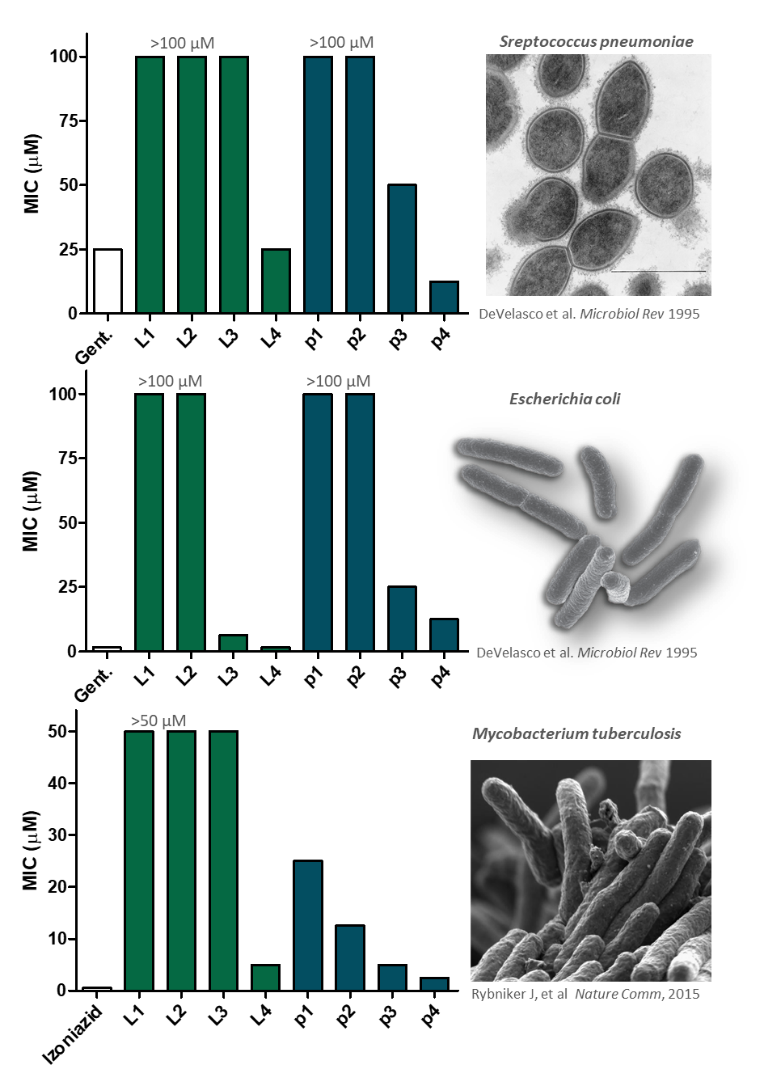
(3) Targeting intracellular pathogens can be achieved by peptide conjugation of antimicrobial drugs. As carrier moieties cell penetrating peptides (CPP), antimicrobial peptides (AMP) and receptor specific peptides are used. The main project of the laboratory is the development of new conjugation strategies for clinically used or recently identified antimicrobial drugs. Besides, development of new antimicrobial peptides with improved bioavailability is also among the research topics.
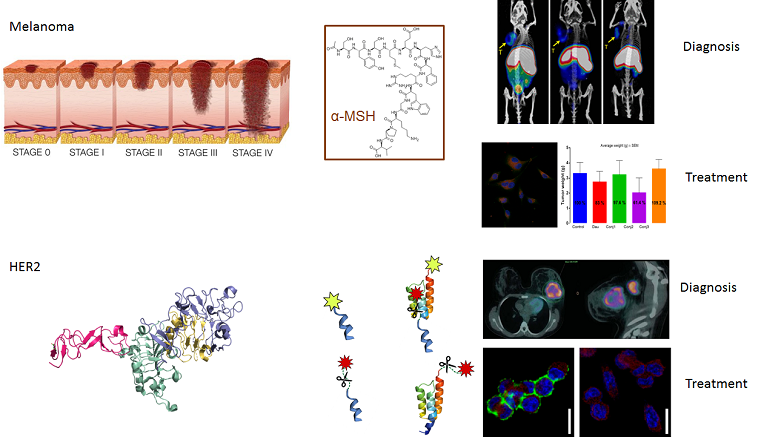
(4) Targeted delivery of drug molecules with antitumor activity. These bioconjugates consist of special peptides to increase the selectivity of the drugs/diagnostics. These carriers are mostly receptor ligands (e.g. α-MSH,), or cancer cell surface specific ligands (primarily phage displayed peptides against HER2 or NG2). Our principal aims with these bioconjugates are increasing the killing of the tumor cells and decreasing the side-effects.
Selected publications:
2025
Bató, C., Szabó, I., Yousef, M., Lenzinger, D., Grébecz, F.K., Visnovitz, T., Bősze, S.E., Bánóczi, Z., Mező, G.:
1-Pyrene Carboxylic Acid: An Internalization Enhancer for Short Oligoarginines. INT. J. MOL. SCI. 26, 2202. (2025)
DOI: 10.3390/ijms26052202
Link...
2024
Mező, G.; Gomena, J.; Ranđelović, I.; Dókus, E.L.; Kiss, K.; Pethő, L.; Schuster, S.; Vári, B.; Vári-Mező, D.; Lajkó, E.; Polgár, L.; Kőhidai, L.; József Tóvári, J.; Szabó, I.:
Oxime-Linked Peptide–Daunomycin Conjugates as Good Tools for Selection of Suitable Homing Devices in Targeted Tumor Therapy: An Overview. INT. J. MOL. SCI. 25, 1864. (2024)
DOI: 10.3390/ijms25031864
Link...
Szabó, I.; Biri-Kovács, B.; Vári, B.; Ranđelović, I.; Vári-Mező, D.; Juhász, É.; Halmos, G.; Bősze, S.; Tóvári, J.; Mező, G.:
Targeting the Melanocortin 1 Receptor in Melanoma: Biological Activity of α-MSH–Peptide Conjugates. INT. J. MOL. SCI. 25, 1095. (2024)
DOI: 10.3390/ijms25021095
Link...
2023
Szöllősi D, Hajdrik P, Tordai H, Horváth I, Veres DS, Gillich B, Shailaja KD, Smeller L, Bergmann R, Bachmann M, Mihály J, Gaál A, Jezsó B, Barátki B, Kövesdi D, Bősze S, Szabó I, Felföldi T, Oszwald E, Padmanabhan P, Gulyás BZ, Hamdani N, Máthé D, Varga Z, Szigeti K.:
Molecular imaging of bacterial outer membrane vesicles based on bacterial surface display. SCI. REP. 13(1):18752 (2023).
DOI: 10.1038/s41598-023-45628-9.
Link...
Tóth G, Horváti K, Kraszni M, Ausbüttel T, Pályi B, Kis Z, Mucsi Z, Kovács GM, Bősze S, Boldizsár I.:
Arylnaphthalene Lignans with Anti-SARS-CoV-2 and Antiproliferative Activities from the Underground Organs of Linum austriacum and Linum perenne. J. NAT. PROD. 86(4):672-682 (2023).
DOI: 10.1021/acs.jnatprod.2c00580.
Link...
2022
Duró C, Jernei T, Szekeres KJ, Láng GG, Oláh-Szabó R, Bősze S, Szabó I, Hudecz F, Csámpai A.:
Synthesis and SAR Analysis of Novel 4-Hydroxytamoxifen Analogues Based on Their Cytotoxic Activity and Electron-Donor Character. MOLECULES. 27(19):6758 (2022).
DOI: 10.3390/molecules27196758.
Link...

Szabó, I; Yousef, M; Soltész, D; Bató, C; Mező, G; Bánóczi, Z.:
Redesigning of Cell-Penetrating Peptides to Improve Their Efficacy as a Drug Delivery System. PHARMACEUTICS. 14, 907. (2022)
DOI: 10.3390/pharmaceutics14050907
Link...
2021
Péter B, Boldizsár I, Kovács GM, Erdei A, Bajtay Z, Vörös A, Ramsden JJ, Szabó I, Bősze S, Horvath R.:
Natural Compounds as Target Biomolecules in Cellular Adhesion and Migration: From Biomolecular Stimulation to Label-Free Discovery and Bioactivity-Based Isolation. BIOMEDICINES. 9(12):1781 (2021).
DOI: 10.3390/biomedicines9121781
Link...
Szabó, I.; Illien, F.; Dókus, E. L.; Yousef, M.; Baranyai, Zs.; Bősze, Sz.; Ise, S.; Kawano, K.; Sagan, S.; Futaki, S.; Hudecz , F.; Bánóczi, Z.:
Influence of the Dabcyl group on the cellular uptake of cationic peptides: short oligoarginines as efficient cell-penetrating peptides. AMINO ACIDS 53 pp. 1033-1049., 17 p. (2021)
DOI: 10.1007%2Fs00726-021-03003-w
Link...
Horváti K, Fodor K, Pályi B, Henczkó J, Balka G, Gyulai G, Kiss É, Biri- Kovács B, Senoner Z, Bősze S.:
Novel Assay Platform to Evaluate Intracellular Killing of Mycobacterium tuberculosis: In Vitro and In Vivo Validation. FRONT. IMMUNOL. 12:750496 (2021).
DOI: 10.3389/fimmu.2021.750496.
Link...
2020

Biri-Kovács B, Adorján A, Szabó I, Szeder B, Bősze Sz, Mező G:
Structure-Activity Relationship of HER2 Receptor Targeting Peptide and Its Derivatives in Targeted Tumor Therapy.
Biomolecules 10(2), 183. (2020)
DOI: 10.3390/biom10020183
Link...
Szabó I, Bősze Sz:
Az Aminosav analízis múltja és jelene a Peptidkémiai Kutatócsoport és az ELTE TTK Kémiai Intézet Szerves Kémiai Tanszék Mikroanalitikai Laboratóriumában.
BIOKÉMIA: XLIV : 4 , 12-26.(2020)
ISSN 0133-845
Link...
Szabó, I.; Bősze, S.; Mező, G.:
Synthesis and in vitro evaluation of drug containing melanoma specific peptide conjugates. (Ed.: Mező, G. Eötvös Loránd University, Budapest, Hungary) pp. 39-44 (2020)
Antimicrobial drugs
Targeted delivery of antitumour drugs
1-Pyrene Carboxylic Acid: An Internalization Enhancer for Short Oligoarginines. INT. J. MOL. SCI. 26, 2202. (2025)
DOI: 10.3390/ijms26052202
Link...
Mező, G.; Gomena, J.; Ranđelović, I.; Dókus, E.L.; Kiss, K.; Pethő, L.; Schuster, S.; Vári, B.; Vári-Mező, D.; Lajkó, E.; Polgár, L.; Kőhidai, L.; József Tóvári, J.; Szabó, I.:
Oxime-Linked Peptide–Daunomycin Conjugates as Good Tools for Selection of Suitable Homing Devices in Targeted Tumor Therapy: An Overview. INT. J. MOL. SCI. 25, 1864. (2024)
DOI: 10.3390/ijms25031864
Link...
Szabó, I.; Biri-Kovács, B.; Vári, B.; Ranđelović, I.; Vári-Mező, D.; Juhász, É.; Halmos, G.; Bősze, S.; Tóvári, J.; Mező, G.:
Targeting the Melanocortin 1 Receptor in Melanoma: Biological Activity of α-MSH–Peptide Conjugates. INT. J. MOL. SCI. 25, 1095. (2024)
DOI: 10.3390/ijms25021095
Link...
2023
Szöllősi D, Hajdrik P, Tordai H, Horváth I, Veres DS, Gillich B, Shailaja KD, Smeller L, Bergmann R, Bachmann M, Mihály J, Gaál A, Jezsó B, Barátki B, Kövesdi D, Bősze S, Szabó I, Felföldi T, Oszwald E, Padmanabhan P, Gulyás BZ, Hamdani N, Máthé D, Varga Z, Szigeti K.:
Molecular imaging of bacterial outer membrane vesicles based on bacterial surface display. SCI. REP. 13(1):18752 (2023).
DOI: 10.1038/s41598-023-45628-9.
Link...
Tóth G, Horváti K, Kraszni M, Ausbüttel T, Pályi B, Kis Z, Mucsi Z, Kovács GM, Bősze S, Boldizsár I.:
Arylnaphthalene Lignans with Anti-SARS-CoV-2 and Antiproliferative Activities from the Underground Organs of Linum austriacum and Linum perenne. J. NAT. PROD. 86(4):672-682 (2023).
DOI: 10.1021/acs.jnatprod.2c00580.
Link...
2022
Duró C, Jernei T, Szekeres KJ, Láng GG, Oláh-Szabó R, Bősze S, Szabó I, Hudecz F, Csámpai A.:
Synthesis and SAR Analysis of Novel 4-Hydroxytamoxifen Analogues Based on Their Cytotoxic Activity and Electron-Donor Character. MOLECULES. 27(19):6758 (2022).
DOI: 10.3390/molecules27196758.
Link...
Szabó, I; Yousef, M; Soltész, D; Bató, C; Mező, G; Bánóczi, Z.:
Redesigning of Cell-Penetrating Peptides to Improve Their Efficacy as a Drug Delivery System. PHARMACEUTICS. 14, 907. (2022)
DOI: 10.3390/pharmaceutics14050907
Link...
2021
Péter B, Boldizsár I, Kovács GM, Erdei A, Bajtay Z, Vörös A, Ramsden JJ, Szabó I, Bősze S, Horvath R.:
Natural Compounds as Target Biomolecules in Cellular Adhesion and Migration: From Biomolecular Stimulation to Label-Free Discovery and Bioactivity-Based Isolation. BIOMEDICINES. 9(12):1781 (2021).
DOI: 10.3390/biomedicines9121781
Link...
Szabó, I.; Illien, F.; Dókus, E. L.; Yousef, M.; Baranyai, Zs.; Bősze, Sz.; Ise, S.; Kawano, K.; Sagan, S.; Futaki, S.; Hudecz , F.; Bánóczi, Z.:
Influence of the Dabcyl group on the cellular uptake of cationic peptides: short oligoarginines as efficient cell-penetrating peptides. AMINO ACIDS 53 pp. 1033-1049., 17 p. (2021)
DOI: 10.1007%2Fs00726-021-03003-w
Link...
Horváti K, Fodor K, Pályi B, Henczkó J, Balka G, Gyulai G, Kiss É, Biri- Kovács B, Senoner Z, Bősze S.:
Novel Assay Platform to Evaluate Intracellular Killing of Mycobacterium tuberculosis: In Vitro and In Vivo Validation. FRONT. IMMUNOL. 12:750496 (2021).
DOI: 10.3389/fimmu.2021.750496.
Link...
2020
Biri-Kovács B, Adorján A, Szabó I, Szeder B, Bősze Sz, Mező G:
Structure-Activity Relationship of HER2 Receptor Targeting Peptide and Its Derivatives in Targeted Tumor Therapy.
Biomolecules 10(2), 183. (2020)
DOI: 10.3390/biom10020183
Link...
Szabó I, Bősze Sz:
Az Aminosav analízis múltja és jelene a Peptidkémiai Kutatócsoport és az ELTE TTK Kémiai Intézet Szerves Kémiai Tanszék Mikroanalitikai Laboratóriumában.
BIOKÉMIA: XLIV : 4 , 12-26.(2020)
ISSN 0133-845
Link...
Szabó, I.; Bősze, S.; Mező, G.:
Synthesis and in vitro evaluation of drug containing melanoma specific peptide conjugates. (Ed.: Mező, G. Eötvös Loránd University, Budapest, Hungary) pp. 39-44 (2020)
Antimicrobial drugs
Targeted delivery of antitumour drugs
Molecular imaging of bacterial outer membrane vesicles based on bacterial surface display. SCI. REP. 13(1):18752 (2023).
DOI: 10.1038/s41598-023-45628-9.
Link...
Arylnaphthalene Lignans with Anti-SARS-CoV-2 and Antiproliferative Activities from the Underground Organs of Linum austriacum and Linum perenne. J. NAT. PROD. 86(4):672-682 (2023).
DOI: 10.1021/acs.jnatprod.2c00580.
Link...
Duró C, Jernei T, Szekeres KJ, Láng GG, Oláh-Szabó R, Bősze S, Szabó I, Hudecz F, Csámpai A.:
Synthesis and SAR Analysis of Novel 4-Hydroxytamoxifen Analogues Based on Their Cytotoxic Activity and Electron-Donor Character. MOLECULES. 27(19):6758 (2022).
DOI: 10.3390/molecules27196758.
Link...
Szabó, I; Yousef, M; Soltész, D; Bató, C; Mező, G; Bánóczi, Z.:
Redesigning of Cell-Penetrating Peptides to Improve Their Efficacy as a Drug Delivery System. PHARMACEUTICS. 14, 907. (2022)
DOI: 10.3390/pharmaceutics14050907
Link...
2021
Péter B, Boldizsár I, Kovács GM, Erdei A, Bajtay Z, Vörös A, Ramsden JJ, Szabó I, Bősze S, Horvath R.:
Natural Compounds as Target Biomolecules in Cellular Adhesion and Migration: From Biomolecular Stimulation to Label-Free Discovery and Bioactivity-Based Isolation. BIOMEDICINES. 9(12):1781 (2021).
DOI: 10.3390/biomedicines9121781
Link...
Szabó, I.; Illien, F.; Dókus, E. L.; Yousef, M.; Baranyai, Zs.; Bősze, Sz.; Ise, S.; Kawano, K.; Sagan, S.; Futaki, S.; Hudecz , F.; Bánóczi, Z.:
Influence of the Dabcyl group on the cellular uptake of cationic peptides: short oligoarginines as efficient cell-penetrating peptides. AMINO ACIDS 53 pp. 1033-1049., 17 p. (2021)
DOI: 10.1007%2Fs00726-021-03003-w
Link...
Horváti K, Fodor K, Pályi B, Henczkó J, Balka G, Gyulai G, Kiss É, Biri- Kovács B, Senoner Z, Bősze S.:
Novel Assay Platform to Evaluate Intracellular Killing of Mycobacterium tuberculosis: In Vitro and In Vivo Validation. FRONT. IMMUNOL. 12:750496 (2021).
DOI: 10.3389/fimmu.2021.750496.
Link...
2020
Biri-Kovács B, Adorján A, Szabó I, Szeder B, Bősze Sz, Mező G:
Structure-Activity Relationship of HER2 Receptor Targeting Peptide and Its Derivatives in Targeted Tumor Therapy.
Biomolecules 10(2), 183. (2020)
DOI: 10.3390/biom10020183
Link...
Szabó I, Bősze Sz:
Az Aminosav analízis múltja és jelene a Peptidkémiai Kutatócsoport és az ELTE TTK Kémiai Intézet Szerves Kémiai Tanszék Mikroanalitikai Laboratóriumában.
BIOKÉMIA: XLIV : 4 , 12-26.(2020)
ISSN 0133-845
Link...
Szabó, I.; Bősze, S.; Mező, G.:
Synthesis and in vitro evaluation of drug containing melanoma specific peptide conjugates. (Ed.: Mező, G. Eötvös Loránd University, Budapest, Hungary) pp. 39-44 (2020)
Antimicrobial drugs
Targeted delivery of antitumour drugs
Natural Compounds as Target Biomolecules in Cellular Adhesion and Migration: From Biomolecular Stimulation to Label-Free Discovery and Bioactivity-Based Isolation. BIOMEDICINES. 9(12):1781 (2021).
DOI: 10.3390/biomedicines9121781
Link...
Influence of the Dabcyl group on the cellular uptake of cationic peptides: short oligoarginines as efficient cell-penetrating peptides. AMINO ACIDS 53 pp. 1033-1049., 17 p. (2021)
DOI: 10.1007%2Fs00726-021-03003-w
Link...
Novel Assay Platform to Evaluate Intracellular Killing of Mycobacterium tuberculosis: In Vitro and In Vivo Validation. FRONT. IMMUNOL. 12:750496 (2021).
DOI: 10.3389/fimmu.2021.750496.
Link...
Biri-Kovács B, Adorján A, Szabó I, Szeder B, Bősze Sz, Mező G:
Structure-Activity Relationship of HER2 Receptor Targeting Peptide and Its Derivatives in Targeted Tumor Therapy.
Biomolecules 10(2), 183. (2020)
DOI: 10.3390/biom10020183
Link...
Szabó I, Bősze Sz:
Az Aminosav analízis múltja és jelene a Peptidkémiai Kutatócsoport és az ELTE TTK Kémiai Intézet Szerves Kémiai Tanszék Mikroanalitikai Laboratóriumában.
BIOKÉMIA: XLIV : 4 , 12-26.(2020)
ISSN 0133-845
Link...
Szabó, I.; Bősze, S.; Mező, G.:
Synthesis and in vitro evaluation of drug containing melanoma specific peptide conjugates. (Ed.: Mező, G. Eötvös Loránd University, Budapest, Hungary) pp. 39-44 (2020)
Antimicrobial drugs
Targeted delivery of antitumour drugs
